Miss one deadline and your truck can sit.
My Compliance watches your filing dates and your driver files, and warns you before anything comes due. It is $14.99 a month. We can also get your CDL drivers into the DOT drug and alcohol testing pool the law requires, from $85 a year.
My Compliance
FMCSA does not send a reminder. When your MCS-150 goes stale or a driver's medical card runs out, you find out at a scale house, at a broker's setup desk, or in an audit. By then it is a violation. My Compliance tells you first, while it is still just a task on your list.
$14.99 a month, and that covers your first truck
Each truck after the first is $5.99 a month, so three trucks run $26.97. Extra trucks are added once you connect your USDOT number. Taxes are included. No contract, and you cancel from your own billing page.
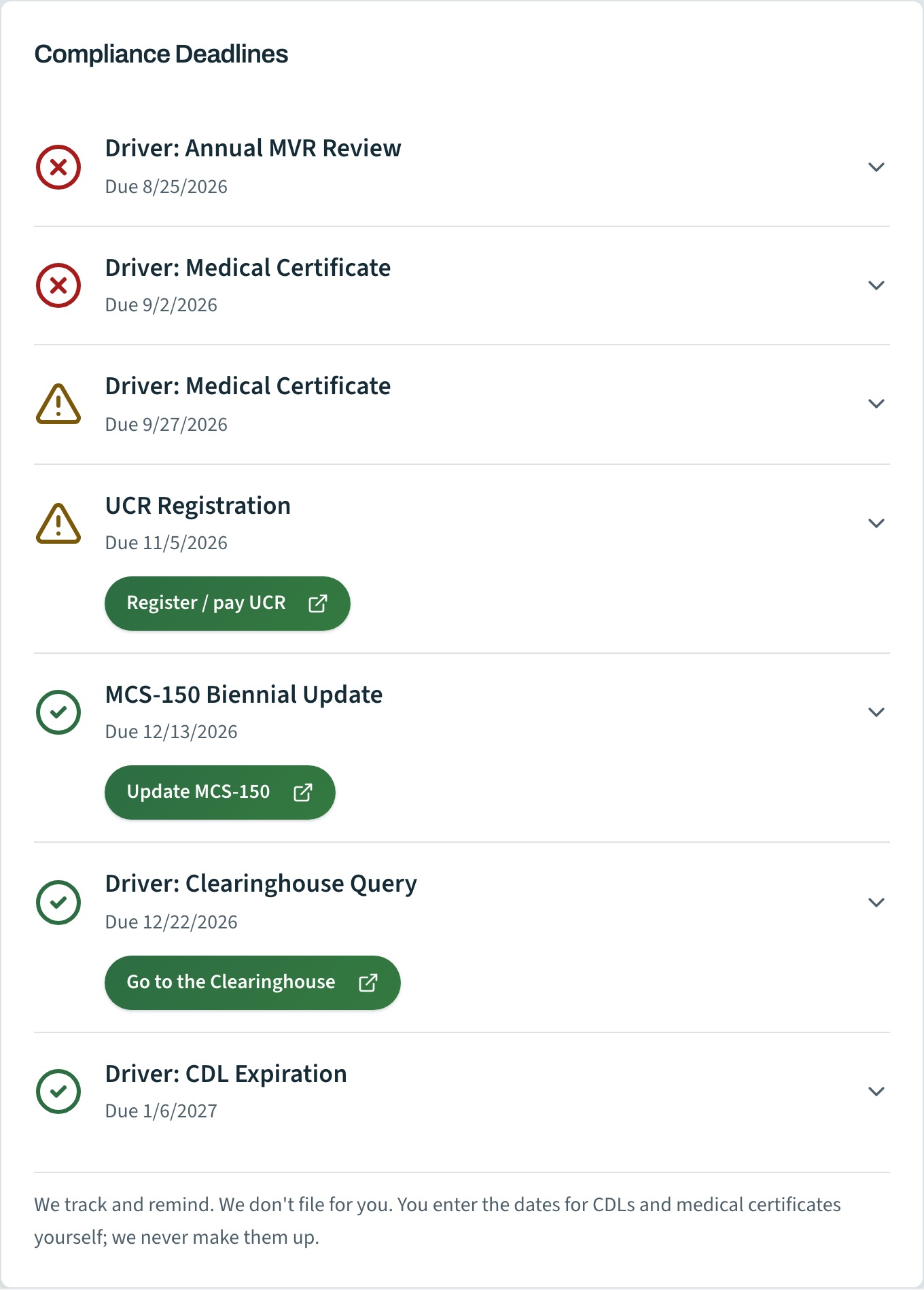
See What Is Late Before Anyone Else Does
Every date in one list, worst first. Red is late, amber is close, and one button takes you to the place you file it. No digging through folders to find out what you missed.
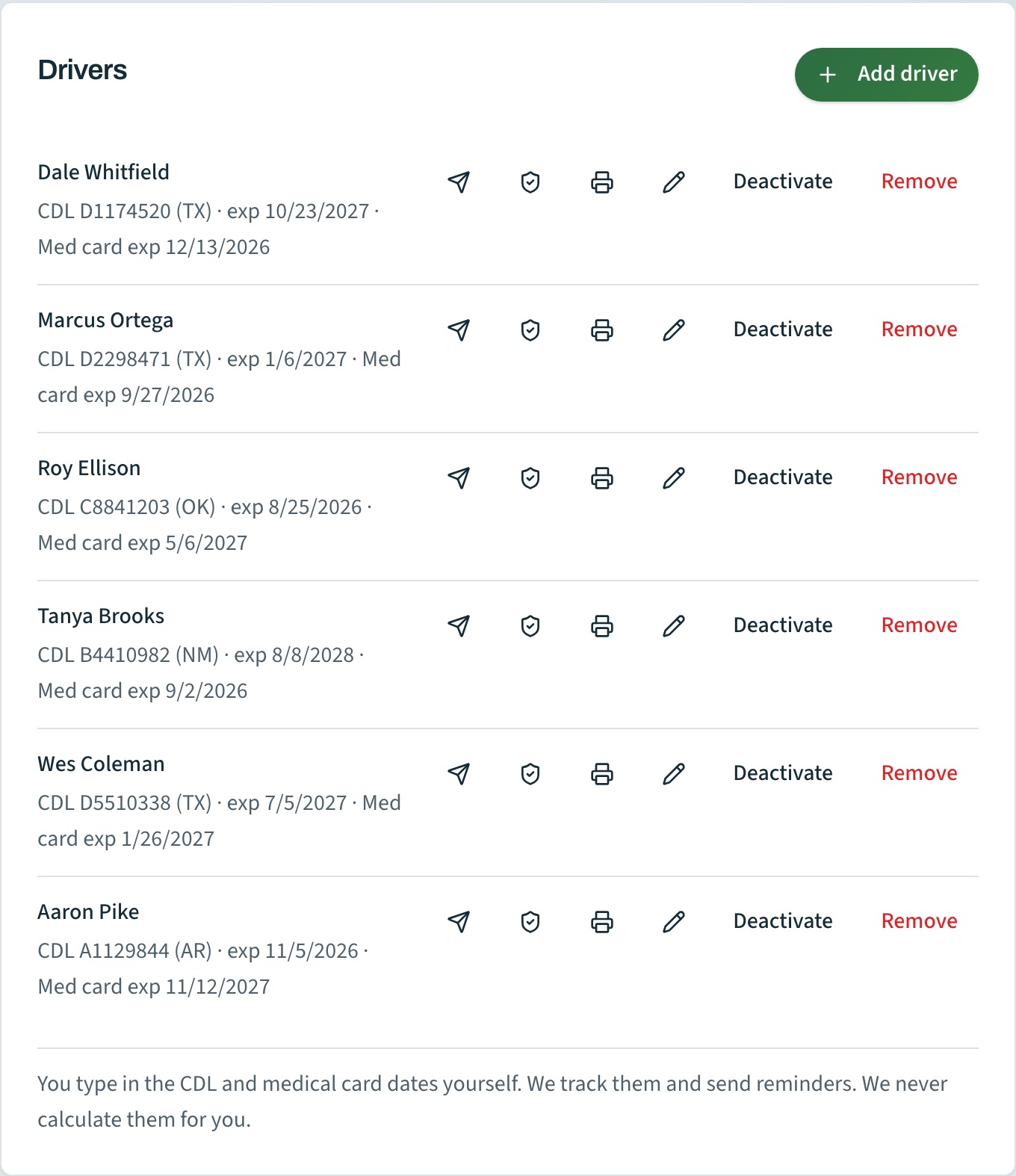
Driver Files Ready for an Audit
One file per driver: the CDL, the license expiry, the medical card and the consent they signed by e-sign link. The rule (Part 391.25) wants each driver's record reviewed once a year. We track that date, remind you when it is due and keep the review in the file. Getting the record itself stays with you or your screening provider.
What $14.99 a Month Covers
- Your MCS-150, UCR, heavy vehicle use tax and all four IFTA quarters on one calendar. Each one warns you before it lapses.
- Your authority, your insurance on file, your BOC-3 and your out-of-service status, checked daily. A change reaches you the day it happens.
- A file per driver: CDL, medical card, annual review, Clearinghouse queries. Consent comes back by e-sign link.
- A live checklist of what a New Entrant or DOT audit asks for. Green is done. Red is what an auditor would ask about.
- Annual inspections, repair records and policy dates, kept where you can produce them.
- A document vault for the paperwork behind all of it, organised by what each file is.
- Annual MVR review reminders
- CDL expiration reminders
- Medical card expiration reminders
- Previous employer investigations, sent and returned electronically
- Clearinghouse query log
- Driver consent by e-sign link, text or email
- Printable driver qualification file
- Vehicle inspection and maintenance log
- Insurance policy tracking
- Random testing pool selections
- Document vault with retention dates
- Records kept for the length the rule requires
The Dates We Track for You
None of these come with a warning. Missing one is rarely a single fine: a lapsed UCR is a roadside violation, a stale MCS-150 can deactivate your USDOT number, and both show up the next time a broker checks you.
| MCS-150 biennial update | Every 24 months. The month is set by your USDOT number, not by when you last filed. |
| UCR registration | Every year, before January 1. Registration for the coming year opens in the fall. |
| Heavy vehicle use tax, IRS Form 2290 | Every year by August 31, for trucks at 55,000 lbs or more. The tax year runs July 1 to June 30. |
| IFTA quarterly returns | Four a year. Each one is due the last day of the month after the quarter ends. |
| Driver medical certificates | Up to 24 months, and often shorter if the examiner says so. |
| Annual vehicle inspection | Every 12 months, per truck and per trailer. |
| Insurance on file with FMCSA | Continuous. A cancellation notice starts a 30-day clock on your authority. |
Walk Into Your New Entrant Audit Ready
Every new carrier spends its first 18 months on New Entrant status, and FMCSA audits it during that time. The auditor asks for driver files, drug and alcohol records, maintenance records and hours of service records. Fail and do not fix it in time, and FMCSA can revoke your registration.
My Compliance keeps a live checklist of exactly what the auditor asks for. Green is done, red is missing. You fix the gaps on your own schedule, not in front of an auditor.
Every CDL driver has to be in a testing pool. Get yours in today.
If you hold a CDL and run under your own authority, federal law says you have to be in a random drug and alcohol testing pool, and it says you can't run one by yourself. This is the one we send our carriers to. It runs the random picks and the Clearinghouse reporting, a doctor reviews every result, and the paperwork an auditor asks for comes with it. It starts at $85 a year.
What it costs
One driver, or a handful
$85 a year
That covers your first driver. Every driver after that is $25 a year. This is what almost every owner-operator pays.
Ten drivers or more
$295 a year
Flat, however many drivers you run. It's worth switching at your tenth driver, which is the point where paying per driver passes $295.
No setup fee. No contract. Cancel whenever you want.
Tests, when you need one
Membership covers the program. Individual tests are billed as you use them, at member rates.
| Pre-employment, random, or post-accident test | $69 |
| Return-to-duty or follow-up test | $99 |
| Breath alcohol test | $59 |
| DOT physical exam | $119 |
| Clearinghouse query | $12 |
| Motor vehicle record | $14 to $40 |
What you get
Your random testing pool
You join a pool of 3,500+ carriers. A computer picks drivers out of it at random through the year, enough to hit the rate the law sets: 50% for drugs and 10% for alcohol, counted against the number of driver spots you run. Picks are spread across all four quarters and every one of them is logged for your records.
A doctor reviews every result
Any result that is not a clean pass goes to the Medical Review Officer, the doctor who reads them. Nothing gets reported until that doctor signs off.
Clearinghouse reporting
A C/TPA runs the program. That is a company the government approves to run drug and alcohol testing. They report your results, and any violations, to the FMCSA Clearinghouse for you. The Clearinghouse is the federal record of who tested and what came back.
Your certificate of enrollment
Emailed within minutes of signing up. It's what you show a broker, a shipper, or an officer at roadside to prove you're covered.
A written policy and a DOT guidebook
A drug and alcohol policy written out for your file, plus a plain-English guide to what the DOT expects of you.
Text and email notifications
When one of your drivers gets picked, the notice goes out with the instructions and the closest places to go. Nothing sits in an inbox until it's late.
Records ready for an audit
Your yearly summary report and your full testing history, kept in order for a New Entrant audit or a DOT audit.
Someone to call, day or night
A real person on the phone for an accident, a reasonable-suspicion call, or a return to duty. Not a chatbot.
How random testing actually works
- 1.
A driver gets picked
Each quarter the computer pulls names from the pool. Everyone has the same odds every time, and each pick is time stamped and logged.
- 2.
The driver hears the same day
The driver gets a text and an email with a prepaid pass and the three closest places to go.
- 3.
They walk in and walk out
No appointment. Any of 20,000+ certified collection sites, a standard 5-panel DOT screen, and they are back on the road the same day.
- 4.
It gets reviewed and filed
The doctor reviews the lab result. It lands in your audit file, and it is reported to the Clearinghouse for you.
Your drivers can test anywhere
Nobody is tied to one clinic. There are more than 20,000 certified collection sites across all 50 states, so when a driver is picked, the notice points them at the closest one to wherever they happen to be that day, even if that's a couple thousand miles from home. They hand over the prepaid pass and give a sample, then get back on the road.
Samples go to SAMHSA-certified labs, which means Quest Diagnostics and LabCorp. The program is administered by an FMCSA-registered C/TPA and follows 49 CFR Parts 40 and 382, the two rules that govern DOT testing.
Why you can't just do this yourself
Random testing only works if there are enough names to pull from, so the FMCSA doesn't let a one-driver carrier run its own. If you're an owner-operator, joining a consortium isn't optional. It applies to any CDL driver in a vehicle over 26,001 lbs, hauling placarded hazmat, or carrying 16 or more passengers. That's 49 CFR Part 382.
Enroll today and you're in the pool today
Your certificate is emailed within minutes, and your name goes into the pool for the next quarterly draw.
Enrollment and testing are provided by a third-party C/TPA registered with the FMCSA. Foundation Freight is not your C/TPA and does not run the pool.
Stop keeping deadlines in your head.
Connect your USDOT number and your calendar fills in on its own. $14.99 a month covers your first truck. No contract, no setup fee.